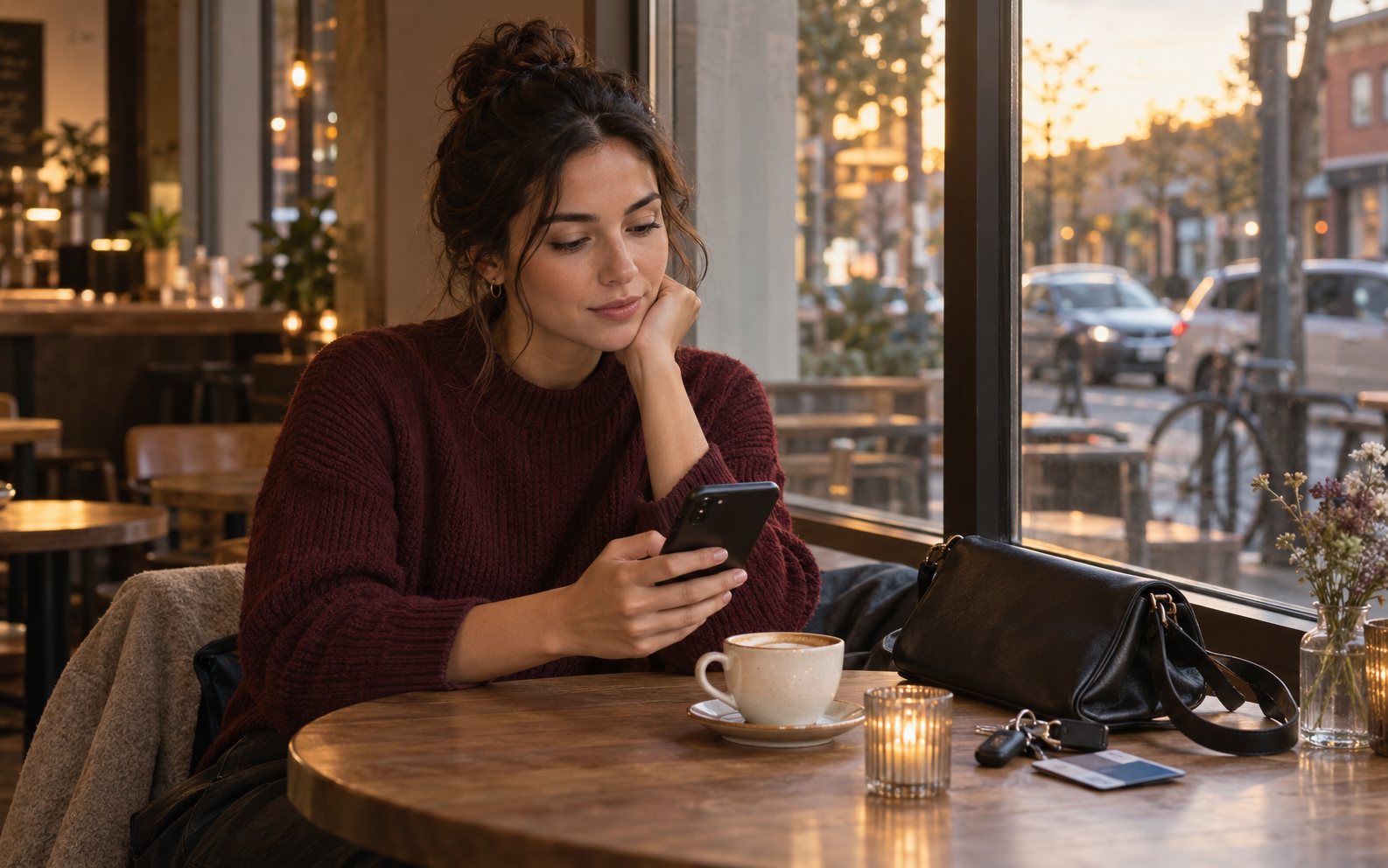
For a first date with someone you do not yet know well, use five practical layers: choose a Public place, Let someone know, Arrange your own transport, Notice how boundaries are treated and Step away whenever you want. None of these steps can guarantee safety or prevent another person from causing harm. They simply preserve options while trust is still developing.
The five-part PLANS check
The most useful plan is brief enough to repeat. It should not require a dossier, expensive technology or a friend monitoring every minute. A public venue, one informed contact, an independent route home, a charged phone and permission to leave cover the decisions most likely to matter during an ordinary first meeting.
Safety advice can easily slide into blame, so the principle is important: responsibility for harassment, coercion or violence belongs to the person who causes it. Preparation is a tool for your comfort and agency, not a test you must pass before deserving safety.
PLANS in one minute
- Public: choose a busy, familiar place with staff and a clear way out.
- Let someone know: share the person’s name or profile, the venue and your expected check-in time.
- Arrange transport: arrive and leave without depending on your date.
- Notice: pay attention to how the person responds to small limits and changes of plan.
- Step away: end the date whenever you feel uncomfortable, pressured or simply ready to go.
For a practical companion to this idea, read move from messaging to a first meeting with clearer expectations.
Before agreeing to meet
Meet only when the timing feels right to you. A match who is enthusiastic can still accept “not yet,” a shorter first meeting or a video call beforehand. Pressure to meet immediately is useful information because it shows how the person handles a limit before you share physical space.
Check that the basic identity and story remain coherent. A brief live video conversation can confirm that the person resembles the profile, while an independent search may reveal obvious contradictions. Avoid demanding identity documents or collecting sensitive information: a passport image creates privacy risk and still cannot prove someone’s intentions.
Save the profile name, photos and the conversation needed to identify the account before leaving for the date. The eSafety Commissioner notes that a profile can disappear if someone unmatches or blocks you, making a screenshot useful if you later need to report conduct. Keep that record private; verification is not permission to publish someone’s information.
Questions to answer before you say yes
- Have we had enough consistent conversation for me to want an in-person meeting?
- Does the profile broadly match a live conversation and other ordinary evidence?
- Has this person accepted a slower pace, a public venue and a defined time?
- Am I choosing the date, or trying to avoid disappointing someone?
A safety plan should make a date easier to enjoy, not make you responsible for another person’s choices.
Choose a public plan with a natural ending
Pick a staffed, populated place that you can locate easily and leave without explanation: a café, restaurant, museum or other public venue that suits the time of day. For an initial meeting, avoid changing the plan to a private home, a remote outdoor area or a location where transport becomes dependent on the other person.
A short format lowers practical and emotional pressure. “Coffee from 6:00 to 7:00” creates a real ending while leaving room to continue if both people want to. An open-ended evening can make leaving feel like a public verdict on the other person, even though ending at any point is always allowed.
Look at closing time, transport availability and phone reception before you go. If accessibility, sensory needs or discrimination affect which spaces feel usable, choose the setting that gives you the most control rather than following a generic idea of the perfect date.
A clear invitation
- “I can meet at the café on King Street from 6 to 7. I’ll make my own way there.”
- “I prefer a public place for a first meeting. The museum café works well for me.”
- “I’m not ready to meet tonight, but I’d be comfortable arranging something next week.”
Continue this topic with set privacy, pace and consent boundaries before meeting.
Tell one trusted person the useful details
Send one trusted person the name or profile of your date, the venue, the scheduled time and when you expect to check in. This is more useful than a vague “I’m going on a date.” Agree on what they should do if you miss the check-in: message once, call, or take another action based on the situation and local emergency guidance.
Location sharing is optional. It can be useful when it is enabled deliberately with someone you trust, but it is not required for a responsible plan. Check who already has access to your location and stop sharing afterward if ongoing access is not what you want. Never share a live route publicly.
A simple code phrase can reduce awkwardness. “How is the blue jacket?” might mean “call me now,” while a single agreed emoji might mean “please arrange a ride.” The phrase should be easy to remember and paired with a specific response rather than leaving your friend to guess.
A message you can copy
- “I’m meeting Sam from the app at North Café at 6. Here is the profile. I’ll text by 7:15; if I don’t, please message and then call me.”
Control your arrival, phone and route home
Arrange transport that does not depend on your date. Walk a familiar route, use public transport, drive yourself, book your own ride or ask a trusted person for a lift. Keep enough battery, fare or payment access to change the plan. If a rideshare is involved, confirm the vehicle and driver in the app rather than accepting a car someone else points out.
You do not need to reveal your home address for convenience. Choose a nearby public pickup point if that better protects your privacy, and avoid allowing a new date to follow you home simply because the evening went well. Interest and address access do not have to progress together.
Keep your phone usable rather than buried at the bottom of a bag with no charge. A portable battery can help on longer journeys, but the essential step is knowing how you will contact your check-in person, transport provider or local emergency services if the plan changes.
For another useful perspective, check identity inconsistencies and romance-scam warning signs.
During the date, watch the response to small boundaries
A first date is not an interview for perfect behavior. Still, ordinary moments reveal whether the other person can hear “no,” accept a preference and adjust without punishment. Notice the response when you decline another drink, keep your phone number private, refuse a change of venue or say you need to leave at the planned time.
Pressure may sound playful: “Don’t be boring,” “You would stay if you liked me,” or “I came all this way.” You do not need to debate whether the comment was serious. Repeat the limit once if you want to, change the situation or leave. Consent to the date is not consent to touch, alcohol, sex, a ride, another venue or a second date.
If you drink alcohol, order and handle your own drink, keep it in view and stop at the level that lets you make the choices you want. Alcohol is not responsible for another person’s conduct, and choosing not to drink should not require an explanation. The same principle applies to any substance that could affect alertness or decision-making.
Short boundary scripts
- “No thanks, I’m staying with this drink.”
- “I’m not changing venues tonight.”
- “Please don’t touch me like that.”
- “I’m heading home now. Take care.”
Leave when you want to leave
You can end a date because you feel unsafe, because a boundary was ignored, because the chemistry is not there or because you are tired. You do not owe a minimum amount of time in exchange for a drink, meal, ticket or journey. Politeness is optional when it conflicts with getting away from pressure.
If a direct goodbye feels safe, keep it short: “I’m going home now.” If it does not, move toward staff or other people, contact your check-in person and arrange transport. You may use an excuse, ask venue staff for help or leave without a final conversation. The goal is not to make the exit socially elegant; it is to preserve your choice.
If someone follows you, blocks your exit, threatens you or you believe you are in immediate danger, move toward a populated or staffed place and contact the emergency service for your location. General online guidance cannot replace local emergency support.
You may also want to keep curiosity separate from assumptions on a modern first date.
After the date: close the loop and protect your privacy
Tell your check-in person that you are safe so they do not have to infer it. Then decide what contact you want next. You can send a warm follow-up, say you do not want another date, unmatch, block or take time before answering. A pleasant date does not obligate you to share an address, social account or new level of access immediately.
If something concerning happened, save relevant messages, the profile, dates, receipts and a brief factual note while details are fresh. Report the account through the platform when appropriate. For unwanted contact, review the privacy settings on messaging and social accounts before blocking if doing so helps you retain evidence or understand what information is exposed.
If you experienced harassment, assault or another form of harm, it was not caused by failing to follow a checklist. Consider contacting a trusted person, a qualified local support service or the appropriate authority based on what you need. This article provides general educational information, not individualized legal, medical or therapeutic advice.
First-date safety questions, answered
Should you share your live location? Only if you want to and trust the recipient. A venue, time and check-in plan can still be useful without continuous tracking. Review the sharing duration so a temporary precaution does not become permanent access.
Should you give a friend the person’s phone number? If you have it, you can include it in the private plan, but do not pressure a date for sensitive details. A profile screenshot and venue may be the information actually available.
Is a daytime date always safer? Daylight can make transport and public activity easier, but the best plan depends on the venue, route, accessibility and your circumstances. “Public, staffed and easy to leave” is more useful than one universal hour.
What if the date wants to pick you up? You can decline without implying distrust: “I appreciate it, but I’ll meet you there.” A respectful person can accept that practical boundary.
Does a verified profile mean the meeting is safe? No. Verification may confirm that a photo matches a user, but it cannot guarantee identity details, intentions or future behavior. Keep the same ordinary first-meeting plan.
Use the checklist to create more freedom, not more fear
A first date can be light, curious and spontaneous while still having structure underneath it. Public place, informed friend, independent transport, usable phone and a clear exit are small decisions that keep more choices available.
Make the plan once, adapt it to your circumstances and then focus on the person in front of you. The checklist is doing its job when it fades into the background and leaves you freer to notice whether the date feels respectful, mutual and worth continuing.
Sources & further reading
Continue with trusted research
- Tips for Safer Dating: Online & IRLRAINN
- Online dating: How to stay safeeSafety Commissioner
- Swipe Smart: Essential Tips for Online DatingUniversity of Michigan Division of Public Safety & Security
This article offers general educational context, not medical, legal or mental-health advice. See our Editorial Policy.